Robots, AI and Us: Centre project

How will robots and artificial intelligence fit into our daily lives?
Back in 2007, in his famous talk "A Robot in Every Home", Bill Gates predicted that "we are at the birth of a new industry (...) [that] could well change the world". This prediction is about to come true, and recent events are already showing the disruptive impact of robotics and artificial intelligence on our society and daily life. We are already seeing how robots are getting closer to humans outside factories. At the same time, AI has shown it can achieve unprecedented levels of natural interaction between humans and machines. It is expected that AI-powered robots will trigger a real revolution, allowing robots to live alongside humans in small workshops, SMEs, as well as in homes, acting as work companions and domestic assistants.
Pero…
What scientific and technological challenges need to be tackled for robots to be perfectly integrated into our daily lives in a cost-effective, socially and ethically sustainable way?
At the Robotics and Automation Centre we are tackling these issues. At CAR robots, AI and humans already coexist. We are working on energy-efficient smart homes, self-driving cars, smart drones, indoor positioning systems, biomedical systems, personal assistants and social robots, IoT-driven manufacturing plants and many other topics. To address the fundamental scientific questions mentioned earlier, it is necessary to join efforts in a collective project at the Centre level.
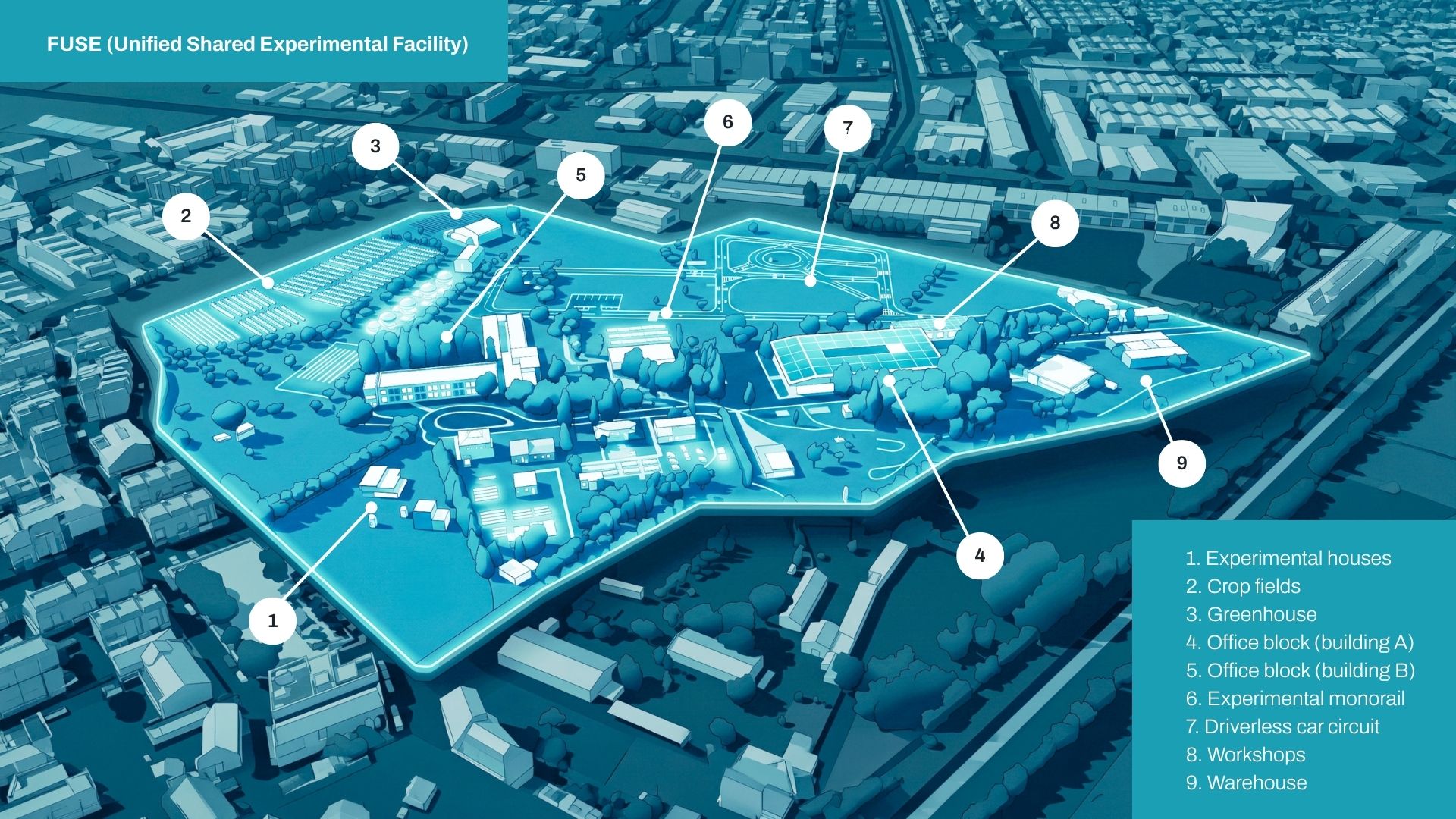
We present to you THE FUSE
FUSE, Unified and Shared Experimental Installation in English, is a small village of the future. It includes experimental houses, office blocks, an extensive network of roads for self-driving cars, fields and greenhouses, a drone flight area and even a track for an experimental monorail train. It is located at the CSIC CAR facilities in Arganda del Rey and includes the UPM CAR Robotics Arena and other CAR laboratories.
Robots, AI and us
The science project Robots, AI and Us CAR uses a 'day in the life of' approach to tackle general science and technology issues.
Our project work focuses on a typical day of an imaginary family (Alex and Ben, their daughter Caroline, Grandma Daisy and Elliot, the robotic domestic assistant) living in the FUSE experimental village and is organised in scenes that take place throughout a typical day, like this:
Alex wakes up at 7 in the morning in his smart, energy-independent home. The house has set the alarm taking into account his schedule and the traffic. Elliot, the home assistant, brings breakfast to the table. The tomatoes Alex will have for breakfast were grown in the small greenhouse in his backyard by his gardening robot. Alex rushes: the driverless car will be at the door at exactly 8 o'clock. The car communicates with other vehicles and traffic management systems to avoid congestion, making on-the-fly decisions to optimise travel time and minimise environmental impact. In the car, Alex chats with a cyber avatar that works with robotic workers in the factory on decentralised autonomous operations that ensure efficient and sustainable production. Once at the plant, he notices mobile robots patrolling the premises for site security and inspection and maintenance of the infrastructure
Ben started his day at 6 am, heading out into the morning light to check on his crops. The farm is sensor-equipped and autonomous ground and aerial robots monitor the field’s condition so he can check the state of the crops on his way. A fleet of small robots is already working to help operators with heavy tasks in the field. Ben is also introducing an augmented reality device in his vineyard to help pickers select the bunches ready to be harvested. These reliable systems ensure optimal efficiency, reduce waste and make farming more sustainable.
At 9 in the morning, Elliot tells the house to wake up Daisy, Alex's elderly mother. It's time for her to take her medicine. After breakfast, Daisy, from the living room, watches over the greenhouse in the backyard and communicates with the gardening robot through her tablet. The robot can autonomously carry out several of the actions needed for the growth cycle of her tomato, cucumber, pepper, eggplant crops and her favourite flowers, the orchids.
Elliot also keeps an eye on the family's daily activities. It can remember scheduled appointments, detect falls, long periods of inactivity, stress, etc. and will reach out to various external devices (specialist therapists, emergency services, etc.) if needed.
At midday, Caroline starts her rehab exercises at home while Grandma Daisy has a doctor's appointment at the local clinic. She books a self-driving accessible car through the home assistant. At the clinic, Daisy will have the help of a robotic rehab system that provides precise, real-time support to both medical professionals and patients, making the overall healthcare experience better.
During dinner, the family gets together and shares stories about their day. They marvel at how AI-powered robotic systems have seamlessly become part of their lives.
Do you want to know more?
Stay tuned and follow us on our social media, exciting news is coming!
Click on the following link to check all the project information in Spanish: CSIC_RobotsAIUS_AplicacionesPlantilla catalogo esp
Click on the following link to check all the project information in English: CSIC_RobotsAIUS_Aplicaciones_Plantilla catalogo ing
This initiative has received support from the MaXCSIC Excellence Award (Ref. DEEP-MaX-2024_CAR)